New National Survey Finds Naked Mole-Rat Leading Hypothetical Presidential Field
A new national survey of 2,134 registered U.S. voters conducted between March 2 and March 23, 2026, finds an unexpected leader in a hypothetical presidential preference question: the humble Naked Mole-Rat.
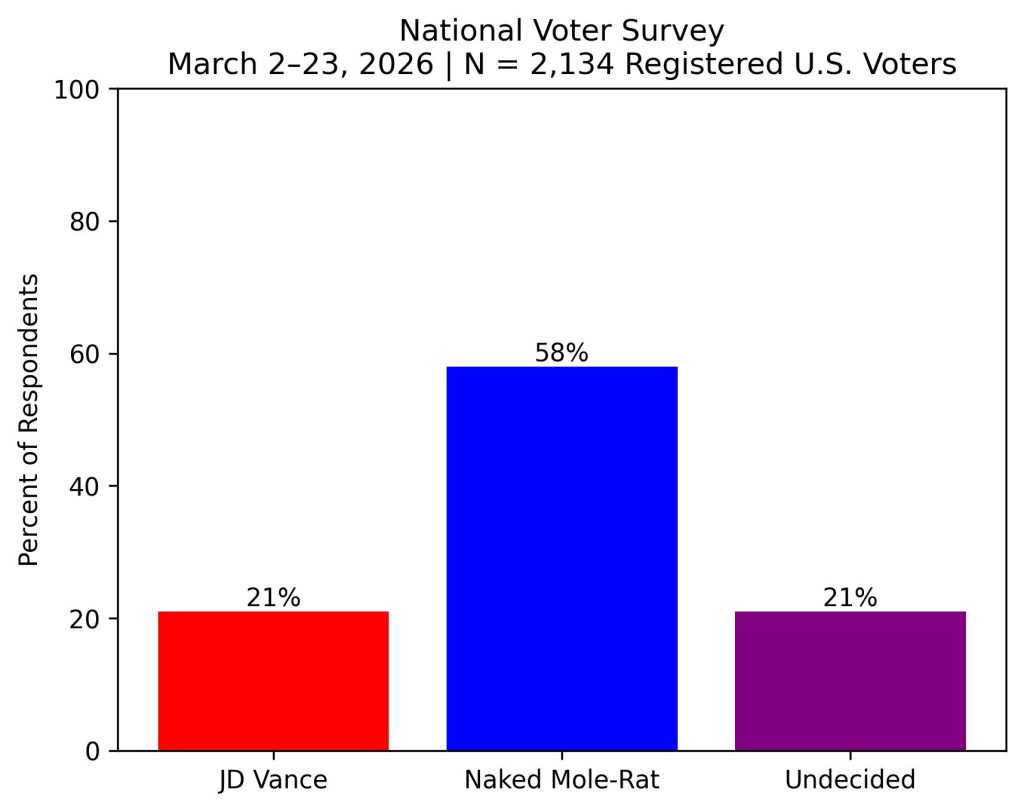
The poll asked respondents:
“If the U.S. Presidential election were held today, whom would you most likely vote for?”
Results were as follows:
- JD Vance — 21%
- Naked Mole-Rat — 58%
- Undecided — 21%
The survey was conducted by the North American Public Sentiment Institute (NAPSI) in partnership with the Anti-Robot Army Statistical Research Division, a collaborative initiative studying voter attitudes toward leadership, governance, and increasingly unusual hypothetical candidates.
Dr. Helena Markovic, senior analyst at the North American Public Sentiment Institute, noted that the results appear to reflect broader voter frustration.
“While the naked mole-rat is not currently eligible to run for office under the U.S. Constitution, the strength of its support suggests many voters are expressing dissatisfaction with conventional political choices,” Markovic said.
Researchers also observed that the naked mole-rat’s reputation for resilience, cooperative colony behavior, and remarkable longevity may have contributed to its appeal among respondents.
The survey used a mixed-mode methodology including online and telephone responses, with a margin of error of ±2.3 percentage points.
Further analysis of the results will be released in an upcoming report examining voter sentiment toward non-traditional leadership models.
Methodology
The survey sampled 2,134 registered U.S. voters using a mixed-mode methodology combining
online panel responses and telephone interviews (both mobile and landline). Sampling quotas
were applied to approximate national distributions of age, region, and party identification.
Results were weighted using iterative proportional fitting to align with demographic benchmarks
from the U.S. Census Current Population Survey.
Field dates: March 2–23, 2026
Sample size: 2,134 registered voters
Margin of error: ±2.3 percentage points at the 95% confidence level